The short version
- An EWC code is a six-digit code from the List of Waste. The first two digits are the chapter, the next two the subchapter, the last two the entry.
- The UK list has 20 chapters and 842 entries. 408 are hazardous, marked with an asterisk.
- Code by where the waste came from first, then by what it is. Household and similar waste is chapter 20; construction and demolition is chapter 17.
- Some wastes have a “mirror” pair: one hazardous, one not. Which applies depends on what is actually in the waste.
- Upholstered domestic seating containing POPs uses 20 03 07, must be described as such, and can’t go to landfill.
How EWC codes work
EWC stands for European Waste Catalogue. In the UK the codes now come from the List of Waste, the list retained in UK law, but most people still call them EWC codes. Each one has six digits in three pairs:
| Digits | Meaning | Example: 20 03 07 |
|---|---|---|
| First pair | Chapter: the source or type of activity | 20, municipal wastes (household waste and similar commercial, industrial and institutional wastes) |
| Second pair | Subchapter | 20 03, other municipal wastes |
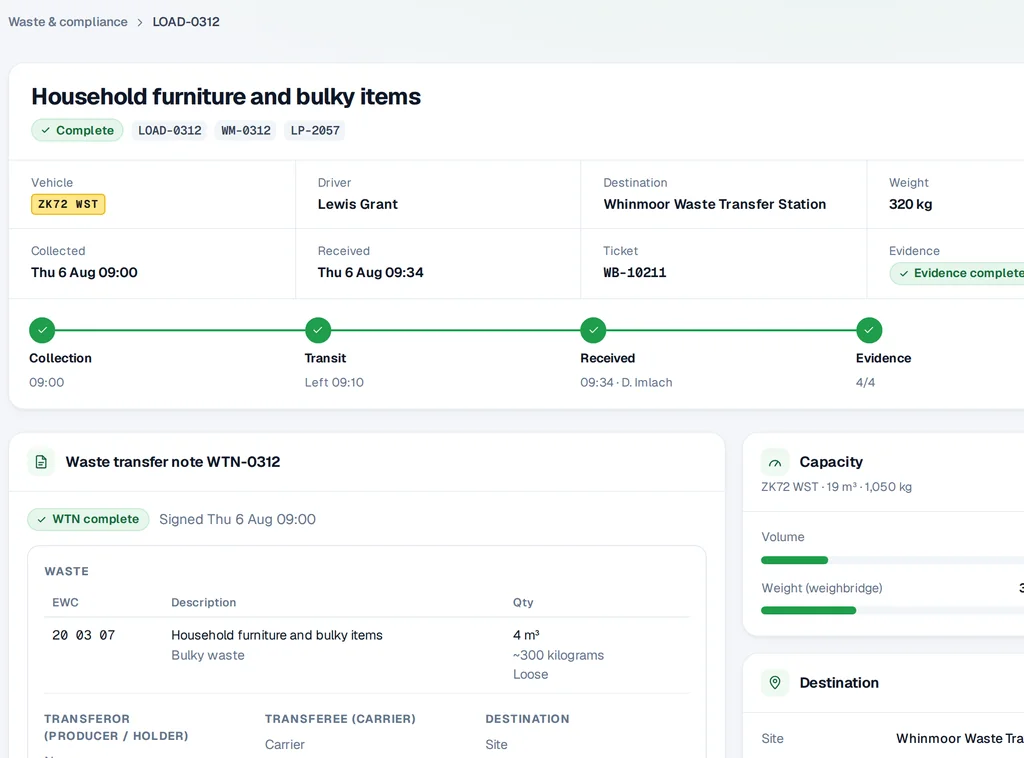
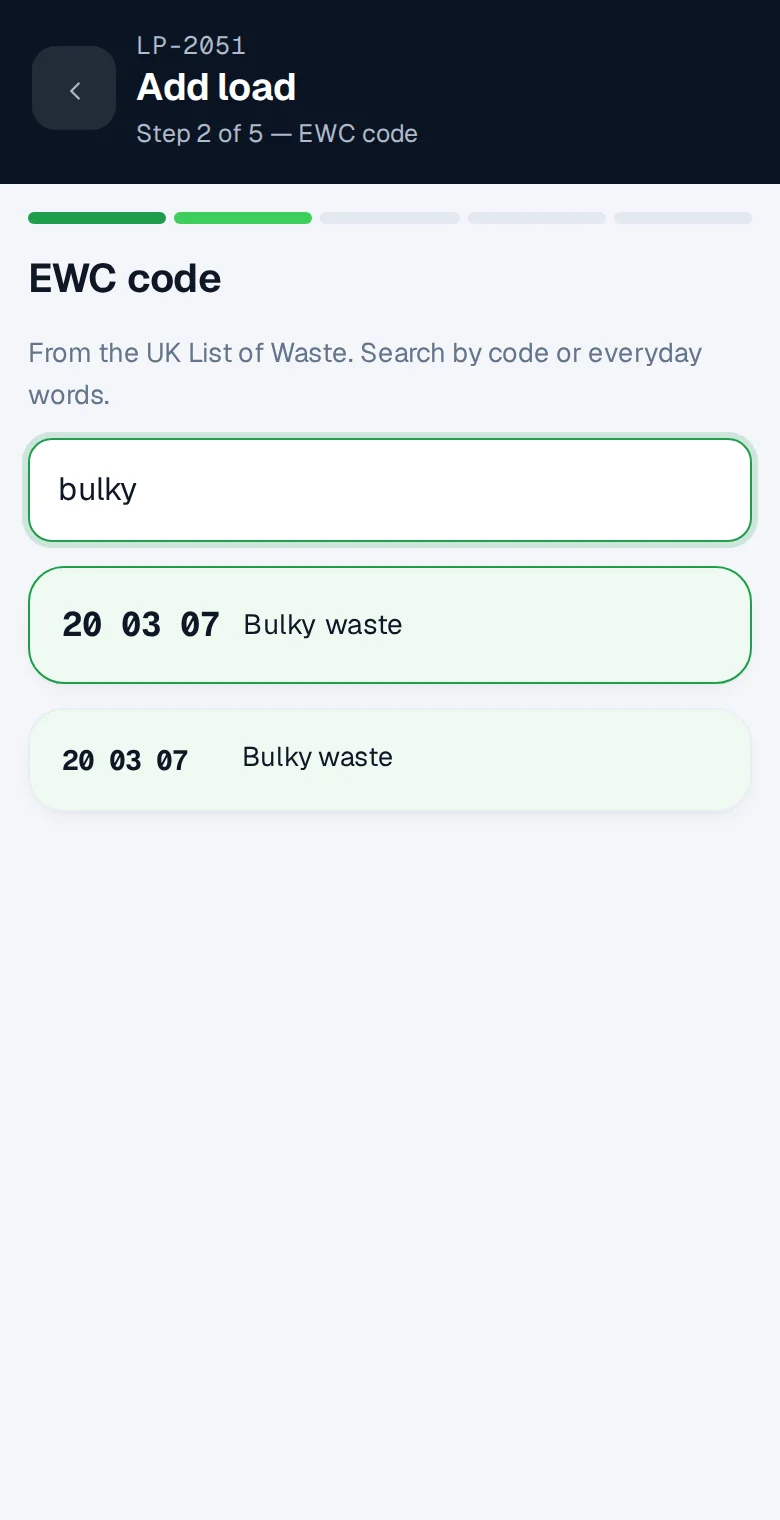
| Third pair | The entry itself | 20 03 07, bulky waste |
The UK list has 20 chapters, 111 subchapters and 842 entries. 408 of those entries are hazardous, and they’re marked with an asterisk, such as 20 01 23*. You can search all of them in our EWC code lookup.

How to pick the right code
- Start with where the waste came from. Waste from a house clearance is household waste: chapter 20. Waste from building work is construction and demolition waste: chapter 17, even when it’s collected from a house.
- Then find what it is. Within the chapter, pick the entry that describes the waste most precisely. If you separated it, code the separated fractions, not the mix.
- Avoid “not otherwise specified” codes ending in 99 when a specific entry fits.
- Check for a mirror entry. If the code says “other than those mentioned in…”, there’s a hazardous twin. See below.
- If you can’t decide, ask before you load. The receiving site or your regulator can tell you what they expect.
Clearance and household waste
| Code | Official description | Typically used for |
|---|---|---|
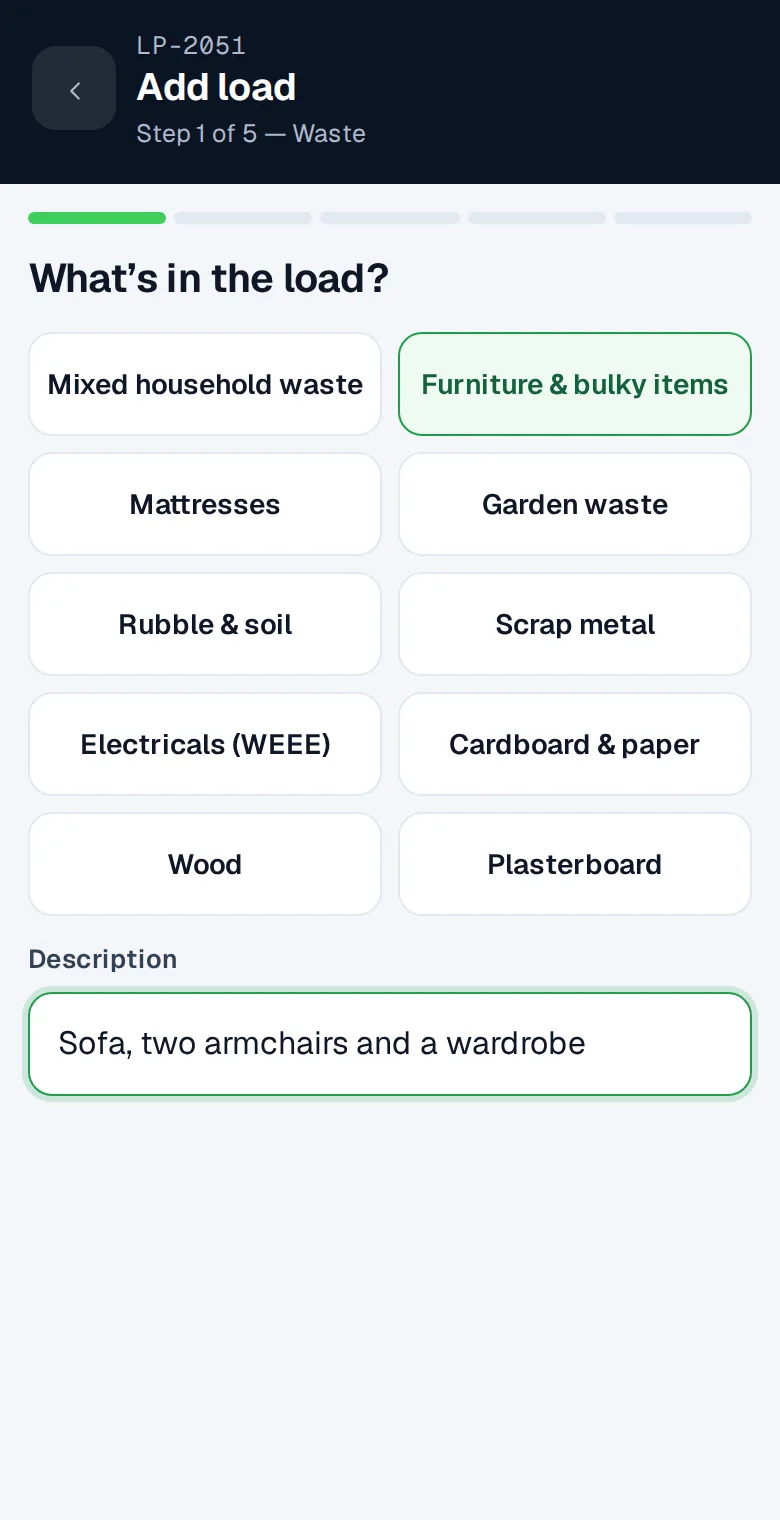
20 03 07 | bulky waste | Furniture and other large household items from a clearance |
20 03 01 | mixed municipal waste | Mixed household rubbish that isn’t separated |
20 01 01 | paper and cardboard | Separated paper and card |
20 01 10 | clothes | Separated clothing |
20 01 11 | textiles | Other separated textiles |
20 01 38 | wood other than that mentioned in 20 01 37 | Separated household wood with nothing hazardous in it |
20 01 39 | plastics | Separated plastics |
20 01 40 | metals | Separated metal |
20 01 36 | discarded electrical and electronic equipment other than those mentioned in 20 01 21, 20 01 23 and 20 01 35 | Electricals without hazardous components |
20 02 01 | biodegradable waste | Garden waste: cuttings, branches, leaves |
Skip, grab and building waste
| Code | Official description | Typically used for |
|---|---|---|
17 09 04 | mixed construction and demolition wastes other than those mentioned in 17 09 01, 17 09 02 and 17 09 03 | Mixed builders’ waste with nothing hazardous |
17 01 07 | mixtures of concrete, bricks, tiles and ceramics other than those mentioned in 17 01 06 | Hardcore and rubble |
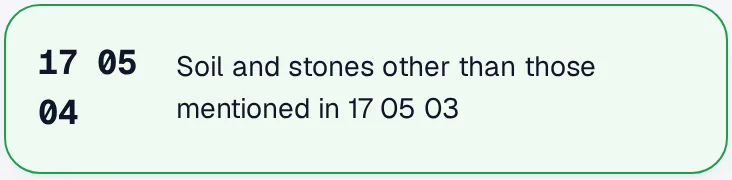
17 05 04 | soil and stones other than those mentioned in 17 05 03 | Clean soil and stones, the usual muck away load |
17 08 02 | gypsum-based construction materials other than those mentioned in 17 08 01 | Plasterboard, kept separate |
17 02 01 | wood | Construction timber |
17 04 05 | iron and steel | Scrap steel from building work |
15 01 06 | mixed packaging | Mixed packaging waste |
16 01 03 | end-of-life tyres | Tyres |
Mirror entries: the same waste, hazardous or not
Some wastes appear twice: once as hazardous and once as non-hazardous. These are mirror entries. You can spot the non-hazardous one because its description ends “other than those mentioned in…”. Which code applies depends on whether the waste actually contains hazardous substances above the thresholds, and that’s an assessment, not a guess. The Environment Agency’s WM3 technical guidance explains how to assess it.
| Pair | What decides it |
|---|---|
20 01 38 / 20 01 37* | Wood: without / with hazardous substances (for example, some treated timber) |
17 05 04 / 17 05 03* | Soil and stones: without / with hazardous substances |
17 09 04 / 17 09 03* | Mixed construction and demolition waste: without / with hazardous substances |
17 08 02 / 17 08 01* | Plasterboard: clean / contaminated with hazardous substances |
20 01 28 / 20 01 27* | Paint, inks, adhesives and resins: without / with hazardous substances |
Hazardous codes these trades come across
Hazardous waste comes with extra rules, including consignment notes in place of transfer notes in many cases. Before you collect any of these, make sure you’re set up and authorised to handle them, and that your receiving site will take them.
| Code | Official description | Typically |
|---|---|---|
20 01 23* | discarded equipment containing chlorofluorocarbons | Fridges and freezers |
20 01 21* | fluorescent tubes and other mercury-containing waste | Fluorescent tubes |
20 01 35* | discarded electrical and electronic equipment other than those mentioned in 20 01 21 and 20 01 23 containing hazardous components | Electricals with hazardous components |
20 01 27* | paint, inks, adhesives and resins containing hazardous substances | Paint that contains hazardous substances (its mirror is 20 01 28) |
20 01 33* | batteries and accumulators included in 16 06 01, 16 06 02 or 16 06 03 and unsorted batteries and accumulators containing these batteries | Lead-acid and other hazardous batteries |
17 06 05* | construction materials containing asbestos | Asbestos. Only handle it if you are set up and authorised to |
Sofas, armchairs and other upholstered seating
Upholstered domestic seating can contain persistent organic pollutants (POPs) from flame retardants. GOV.UK’s guidance for England covers sofas, armchairs, recliners, dining and kitchen chairs, stools, futons, bean bags, cushions and similar household seating with leather, synthetic leather, fabric or foam parts. It doesn’t cover mattresses, curtains, blinds, beds or non-upholstered items. Scotland has its own SEPA guidance.
- Use
20 03 07and describe it on the transfer note as “domestic seating waste containing POPs”. - Landfill sites must not accept it, whether separate or mixed in with other waste. It goes to an incinerator or cement kiln authorised for POPs waste.
- Keep it separate from other waste. If it’s mixed in, the whole load has to be managed as POPs waste until the seating is separated.
- It can share a vehicle with other waste as long as it isn’t mixed with it, doesn’t contaminate it, and is separated when unloaded.
This changes what a clearance costs: a load with sofas in it needs the right destination. See how to price a house clearance.
Coding loads in Oprivo
Sources
- legislation.gov.uk: List of wastes (Commission Decision 2000/532/EC, Annex, as retained in UK law)
- GOV.UK: Waste classification technical guidance (WM3)
- GOV.UK: Manage waste upholstered domestic seating containing POPs (updated 29 July 2026)
- SEPA: Waste upholstered domestic seating containing POPs
- NetRegs: Waste transfer notes and how to complete them
- GOV.UK: Digital waste tracking, check if you need to report the waste you receive (updated 19 October 2026)
Last checked 3 November 2026. Rules and dates can change, so check the official guidance for your nation before relying on them. This guide is general information, not legal advice.