
The short version
- If you’re permitted or licensed to receive controlled waste, you report every load you receive to the government’s Report receipt of waste service.
- England and Wales: mandatory since 1 October 2026. Scotland and Northern Ireland: January 2027.
- Each record must be submitted within 2 working days, counted from the day after the waste arrives.
- You can report through compatible software or Defra’s template spreadsheet, which is expected to stay until at least October 2027.
- Waste transfer notes, consignment notes and your permit’s waste returns all continue alongside it.
Who has to report
GOV.UK says that if you are licensed or permitted to receive controlled waste, you need to enter details of every load you receive. That covers permitted operations, installations and mobile plant. Most household, commercial and industrial waste is controlled waste.
Some sites don’t need to report, according to GOV.UK as of 3 November 2026:
- Household waste recycling centres in Wales, and those in England that receive household waste from residents.
- Sites operating under waste exemptions, which are planned for a later phase with no date set.
- Digitally excluded businesses, which keep written records instead. This applies where digital tools are impractical because of age, disability or location, or for religious reasons. Preferring paper, unfamiliarity with software or extra cost don’t qualify.
| Where the waste is received | Mandatory from |
|---|---|
| England and Wales | 1 October 2026 |
| Scotland and Northern Ireland | January 2027 |
The 2 working day deadline
Records must be submitted within 2 working days, excluding weekends and bank holidays, counted from the day after the waste is received. A load that arrives on a Friday is due by the end of Tuesday, or later if a bank holiday falls in between.
For a small site the deadline itself is rarely the problem. The problem is chasing missing details from a carrier after the lorry has left. The fix is to get everything at the gate.
What goes in each record
GOV.UK lists what the service collects for each load:
- Waste movement details
- Carrier and receiver details
- Waste classification codes (EWC codes from the List of Waste)
- Recovery and disposal codes
- Persistent organic pollutant (POP) data
- Hazardous waste data, including hazard property codes and component concentrations
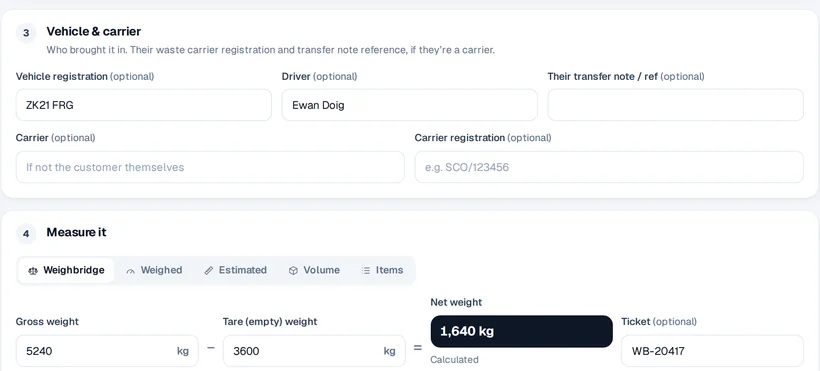
In practice, that means you need at the gate: who brought it, their carrier registration, the vehicle, what the waste is and its code, how much there is, and where it came from. If a carrier’s paperwork is vague, it’s now your problem within two working days. Our guide to EWC codes covers the codes most loads from clearance, skip and grab firms carry.
Two ways to report: software or the spreadsheet
| Route | How it works |
|---|---|
| Software connected to the service | Your waste software sends records to the service through its API. The software must be integrated with the API, and its provider must have run Defra’s production approval test scenarios and self-certified the results. Defra publishes a list of providers. |
| Defra’s template spreadsheet | For sites without connected software. You use Defra’s template unchanged, can add several movements before submitting, and start a new spreadsheet for each later submission. GOV.UK expects this route to stay until at least October 2027. |
Check any provider against Defra’s published list before relying on it to submit for you.
What still applies alongside it
Until further notice, GOV.UK says you must keep doing the following as well:
- Waste transfer notes and Annex VII forms. See how to fill in a waste transfer note.
- Hazardous waste consignment notes, each entered as a separate entry in the service.
- Waste returns under the conditions of your environmental permit.
- Hazardous waste consignee returns, with charges still applying.
Recording receipts in Oprivo
Sources
- GOV.UK: Digital waste tracking, check if you need to report the waste you receive (updated 19 October 2026)
- GOV.UK: Report receipt of waste (updated 19 October 2026)
- GOV.UK: Digital waste tracking service (updated 1 October 2026)
- GOV.UK: Report receipt of waste, choose a software provider
Last checked 3 November 2026. Rules and dates can change, so check the official guidance for your nation before relying on them. This guide is general information, not legal advice.

